Why do you owe taxeson money that isn’t in the bank?
Because profit and cash aren’t the same thing... and connecting them is nobody’s job. Core puts your books, your taxes and a CFO on one team, led by Barry Roach Jr., an Enrolled Agent.
2 minutes. If it’s a fit, you pick a time with Barry. No obligation.
Questions you shouldn’t have to answer alone, at 11pm, in a spreadsheet.
Said to us on real calls. Names left out, words left in.
Your tax bill is figured on profit. Your bank account runs on cash.
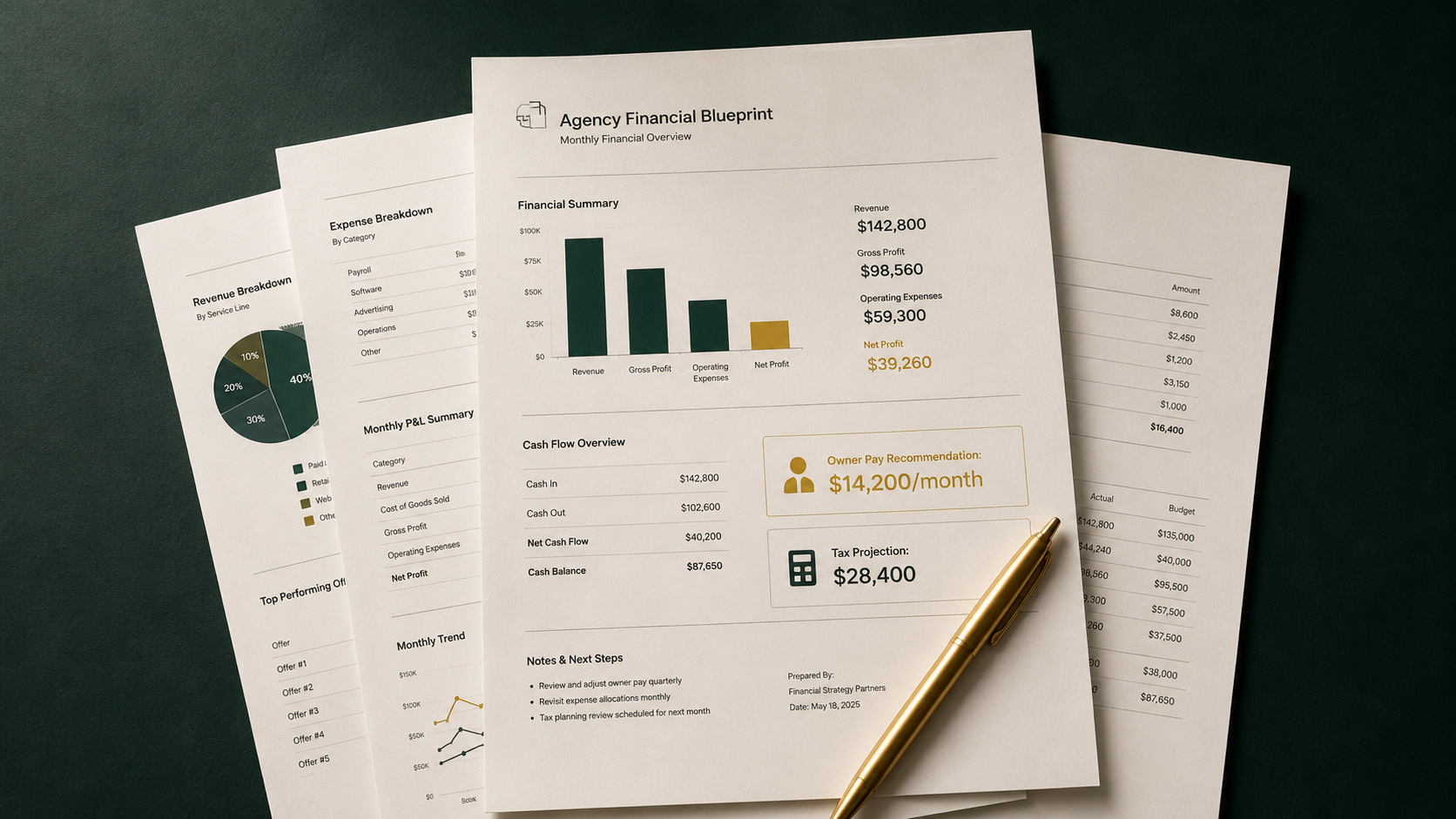
You already know profit and cash aren’t the same number. The difference between them usually hides in a few places.
Loan principal, which never shows up on your P&L. Distributions you took. Equipment you paid for now but deduct over several years. And last year’s tax bill, paid out of this year’s cash.
None of that is a mistake. It’s how money moves in a company that’s growing... and the IRS taxes the profit, not the bank balance.
So somebody has to connect those things every month, before you decide what to pay yourself or who to hire. Could you explain to your banker today why your profit doesn’t match your cash?
You don’t have a bad accountant. You have a setup nobody’s in charge of.
A lot of companies hit $3M with the finance setup they had at $500K. A bookkeeper who categorizes transactions. A CPA who files once a year. A payroll company. Maybe a tax strategist somebody swore by.
Your bookkeeper records what already happened. Your CPA files it next spring. Both may be good at their jobs. Nobody owns the next twelve months.
Nobody was paid to ask the bigger questions... so nobody asked them.
That leaves you as the middleman, carrying numbers between three firms at night. And whoever does that job well needs two things on the same desk: the books and the tax plan.
Every decision has a tax answer. You should hear it before you decide, not in April.
Taking a big distribution. Buying equipment. Adding a location. Bringing in a co-owner. Each one changes your tax bill. When your tax person hears about it at year end, the answer shows up after it could help you.
So here, one team does all four jobs from one set of numbers. Books close by the 15th, a controller reviews the balance sheet, and the cash forecast rolls forward.
Every quarter, the tax plan updates from those same numbers. Then we meet, and your open decisions get answered with the tax already in them.
And the team’s led by Barry Roach Jr., an Enrolled Agent. If the IRS ever writes, the person who planned your taxes is the one who answers.
That’s how the tax on money that isn’t in the bank stops being a surprise. Your estimates, your distributions and your cash forecast come from the same numbers. So the tax bill gets planned into your cash months ahead, instead of discovered in April.
You stop carrying the numbers between firms. When somebody asks what you can afford, you already know.
2 minutes. If it’s a fit, you pick a time with Barry. No obligation.
Bookkeeper, controller, tax and CFO. Four jobs on one team, from one set of numbers.
Core Accounting & Consulting Group is an outsourced finance department and outsourced CFO firm for service businesses doing $3M-$50M, led by Barry Roach Jr., EA. Every month, that covers four jobs.
Bookkeeping
Books closed by the 15th, every month. Each account reconciled to its source: the bank, the payment processor, payroll. So the profit on your P&L is a number you can make a decision on.
Controller
Accrual statements, which put revenue and costs in the month they belong to. A balance sheet somebody actually reviews. And a short dashboard of the numbers that run your business, in plain English.
Tax
Business and personal returns, a tax plan and estimates updated every quarter, and owner pay set on purpose. Done in-house by the people who closed your books... so nothing gets lost in a handoff.
CFO advisory
A rolling cash forecast, a budget, an owner pay plan and a monthly call about the decision on your desk. The next hire. The bigger ad budget. The second location.
What we don’t do, and why: paying bills or chasing invoices (A/P and A/R), and inventory, WIP or job costing. Those are daily, transaction-by-transaction jobs, and we built this around the monthly close and the decisions that come out of it.
Payroll stays with your payroll provider, and we work with them. We use QuickBooks Online only, so every set of books closes the same way by the 15th.
Somebody promised you $100K in tax savings. Read the fine print first.
Your feed is full of it. Buy the rental. Accelerate the depreciation. Save six figures.
What gets left out... a lot of those savings are timing. You deduct now, and much of it comes back as tax when you sell. Some of it needs a “well, technically” to explain.
And the most you can ever save in taxes is your tax bill. Spending a dollar to save thirty cents isn’t a win.
Profit has no ceiling like that. A few points of margin, kept year after year, compounds. It also raises what the company is worth if you ever sell.
So we do both, in that order. Grow the profit first. Then take every deduction you’re entitled to, the kind you’d be comfortable walking an IRS agent through line by line.
Ninety days to a monthly rhythm. Under 5 hours of your time in month one.
Days 1-30, we clean up and close
Access, reconciliations, up to 12 months of catch-up, a cleaner chart of accounts, and a hard look at your taxes and owner pay.
Days 31-60, you see the numbers
Your first monthly package, with a KPI dashboard (the handful of numbers that run your business), a rolling cash forecast and a full-year tax projection.
Days 61-90, we plan
A budget, your owner pay plan, the first quarterly tax plan, and answers on the decisions you’ve been putting off.
After day 90: books closed by the 15th, a review call every month, the tax plan updated every quarter, returns filed. Your time drops to under 3 hours a month.
Built for the service business that outgrew its $500K finance setup.
- You’re doing $3M-$50M in revenue, you have a team, and there’s probably a bookkeeper on it already.
- Services are what you sell, ideally recurring: an agency, IT or MSP, consulting or training, insurance, recurring home or commercial services, recruiting, coaching or education.
- You’re tired of being the one who connects everybody. The bookkeeper, the CPA, the payroll company and whoever else touches your numbers.
- You want to grow on purpose, and maybe sell someday, with numbers that hold up when a buyer or a banker looks closely.
- QuickBooks Online is your system, or you’re willing to move. We quote the move before you sign.
Probably not a fit: inventory-heavy businesses, or construction and manufacturing that needs job costing. Under $3M in revenue? You’re early for this, and that’s fine. Business IQ Edge has the guides and tools for that stage. Start at Business IQ Edge.
One published monthly price for all four jobs. Check it against what you pay now.
$5,000 a month if you’re doing $3M-$10M. $7,500 for $10M-$20M. From $10,000 for $20M-$50M. Above $50M, CFO-only work is priced on its own.
That covers the monthly close, controller review, business and personal tax planning, and the CFO work. Returns cover one operating entity plus the owners’ personal returns.
Run the math as a share of revenue. $60,000 a year is about 2% of $3M... and about 0.6% of $10M.
Then add up what you pay today. Your bookkeeper’s monthly bill. Your CPA’s annual fee, divided by 12. Any strategist or fractional CFO on top. Then the hours you spend being the middleman. You have those numbers. We don’t, so we won’t guess.
No onboarding fee. Cleanup of up to 12 months behind is included. Anything further behind, or a move to QuickBooks Online, gets quoted before you sign. Month-to-month with 30 days’ notice. And if we didn’t do the job to your standard, you can ask for your most recent month back. Month one or month 36. See all pricing.
2 minutes. If it’s a fit, you pick a time with Barry. No obligation.

What owners ask before they spend 30 minutes with Barry.
Why do I owe taxes on money that isn’t in the bank?
Because tax is figured on profit, not on cash. The loan principal you paid down and the distributions you took both left the bank... and neither one lowers the profit you’re taxed on. At Core, the team closing your books by the 15th also plans your taxes every quarter. So you see the bill coming while there’s still time to plan.
I already have a CPA. Do I need to switch?
For your returns, yes, at the next filing cycle. Core’s finance department includes your business return and the owners’ personal returns. That’s the point: the tax answer only shows up before a decision when the people planning your taxes also keep your books. We coordinate the handoff with your current preparer. Filing the return accurately was their job. Planning the year ahead is what’s been missing.
My books aren’t that complicated. Do I really need this?
Maybe not for the books. At $3M and up, the decisions are: what to pay yourself, whether a hire pays for itself, what this year’s profit does to your taxes. That’s what the $5,000 a month is really for. If your books and your decisions are both simple, Barry will say so on the fit call... and point you somewhere that costs less.
From here you’ve got three honest options. Keep the setup you have. Hire and manage the four roles yourself. Or hand all four jobs to one team.
If your numbers looked exactly like this six months from now, would that be okay?
If not, take the 2-minute fit check. If it’s a fit, you pick a time for a 30-minute call with Barry. If it isn’t, he’ll say so plainly and tell you who might be.
See if we’re a fit →